Orphan Longroofs - Part 6
/Where’s the LeMans?
Devoted to remembering the lost automakers - great and not so great - of the last seventy-five years
Dedicated to remembering the lost car makers, the orphaned brands that are such a rich and entertaining piece of American automobile history.

Where’s the LeMans?
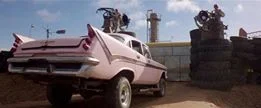
The DeSoto automobile was launched in 1928 as part of a new and rapidly expanding Chrysler Corporation. Conceived to do battle in the fast growing mid-priced range, DeSoto‘s position in the price/prestige strata was between the budget-minded Plymouth and the luxurious Chrysler. Through a series of events, DeSoto was also wedged sometimes awkwardly alongside a newly acquired but well-established Dodge brand. With such a family dynamic is it any wonder that throughout its 33-year history DeSoto struggled for recognition. Ask any DeSoto devote’ and they will rattle off half a dozen delightful models. But to the average car buff, the name is but a blip on the screen of automobile awareness. DeSoto’s anonymity is especially true for those of us born after 1960, the marque’s final year. We know the stunning 1957 Adventurer, of course, with its graceful soaring lines and mighty Hemi engine, arguably the apex of 1950s American automotive design. After that, the marque is mostly remembered in B&W images of 1940s taxicabs from old movies on the late show. Such was the DeSoto lot in life; a middle child forever fighting for its rightful place within the Chrysler family of cars.
Read MoreAt the end of every year, car manufactures crunch the numbers and conclude that some models just aren’t pulling their weight. Twelve of them didn’t make the cut for 2022. Some of the passings will induce tears, others cheers, and a couple might warrent a “huh?,” cause we didn’t know it was still around.
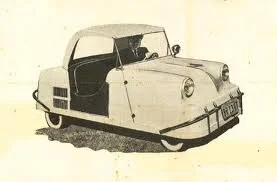
Read MoreTo call the Autoette a car is a bit optimistic. This tiny 3-wheel electric vehicle was developed just before the war by Robert Tafel, an electrical engineer from Long Beach, California. He meant it to be used mainly as a wheelchair for polio sufferers and retirees of which Long Beach had fair number. In wartime, they were used by the military to move materiel around local warehouses quickly without using any precious gasoline. After the war, an entrepreneur named Royce Seevers began making them for public consumption under the Autoette trade name.
Read More
www.ClassicCarsTodayOnline.com
The El Morocco was based on the 1956-57 Chevy Bel Air. It was an attempt to make a Cadillac for the price of a Chevrolet. It turned out however to be a Chevrolet for the price of a Cadillac. But it seems that about three dozen customers over two years still thought the El Morocco was darned pretty cool.
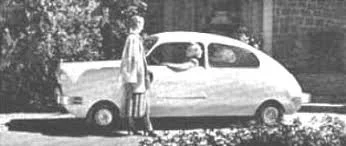
Theodore Parsons Hall took a roundabout route to becoming a carmaker. After earning an engineering degree in 1931 at the Massachusetts Institute of Technology, he went on to work for Consolidated Vultee Aircraft Corporation (CONVAIR) out in San Diego. He eventually became chief development engineer on first the PBY Catalina maritime reconnaissance plane, and then the B-24 Liberator heavy bomber. If some of those names sound familiar, it is because Hall was working at the very same facility where John Leifeld spent his spare time developing the Bobbi-Kar - which, after flim-flam man S.A. Williams was shown the door, became the Keller (Chapter 3). It is possible that the Bobbi-Kar’s designer even worked for Hall at some point during the war years. But while Liefeld was an automotive engineer from Detroit drafted to build airplanes, T.P. Hall was an aeronautical engineer who would make cars fly.
Read MoreThe Imp was a tiny 2-seat runabout designed and built by R.K. Griffin in Pasadena, CA. It was promoted as “A Little Car with a Big Future.” And by far the Imp’s most futuristic feature was its one-piece fiberglass body - making the Imp, when it was unveiled in 1948, one of the very first cars to use this new low cost molding technology.
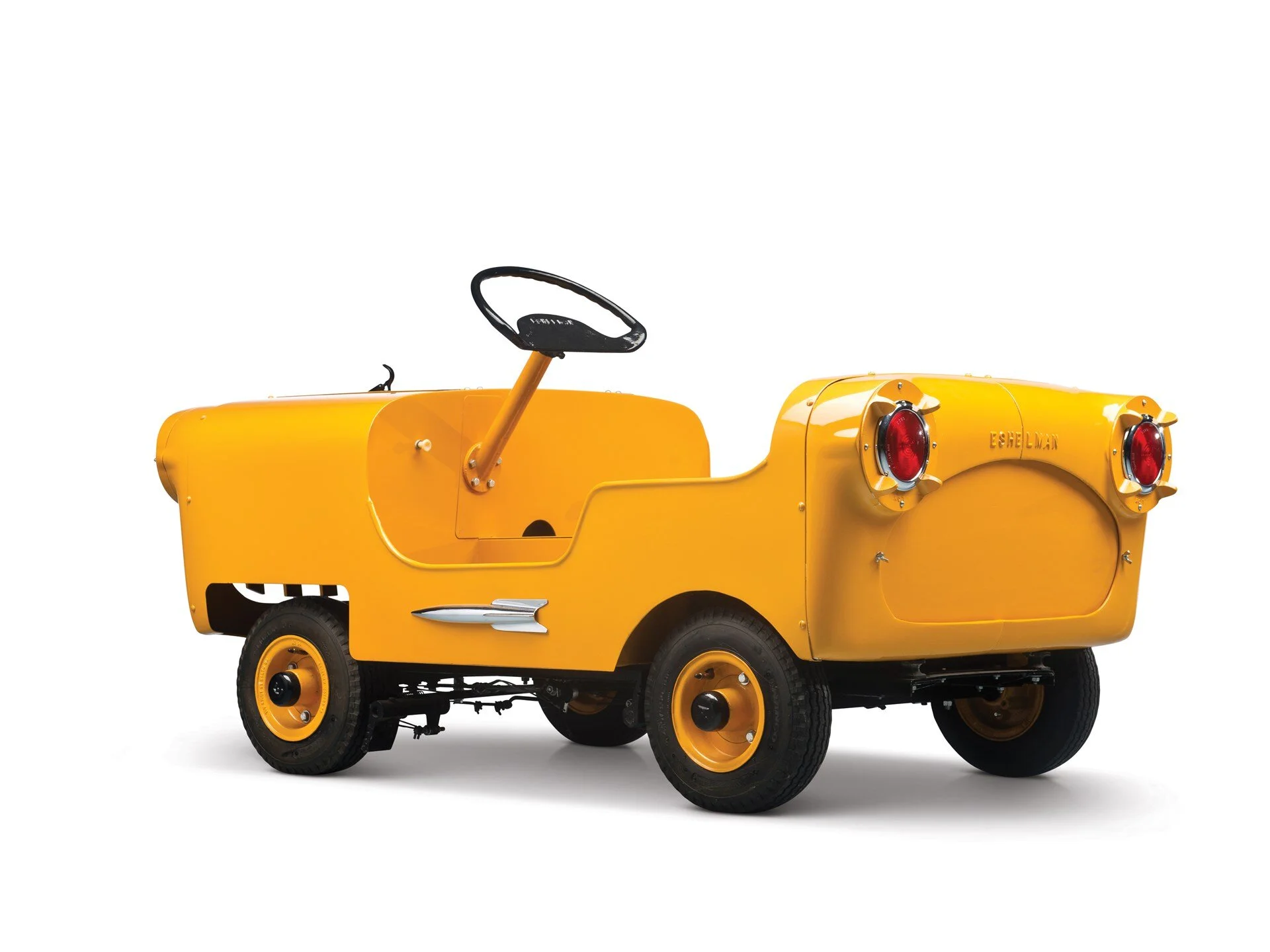
Read MoreThe C.L. Eshelman Co. of Baltimore, Maryland made lawn mowers, roto-tillers and children’s peddle cars. They also built some actual cars…sort of.
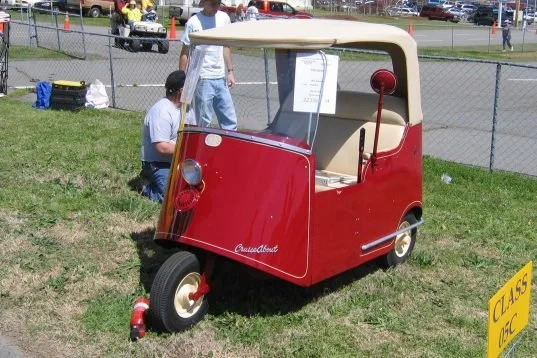
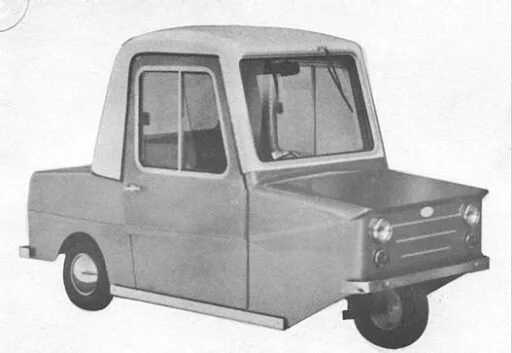
Read MoreDuring the 1960s and 1970s, the self-proclaimed “King of the Electrics” was the Electra-King, made by B&Z Industries of Long Beach, California. During the first half of the King’s 17-year reign it was not much more than a 3-wheeled golf with an enclosed body. Its six-6V batteries powered a 1hp army surplus tank turret motor that could propel the 500lb cart to 18mph. That was probably plenty fast, as the E-K had no front brakes. After an ownership change in 1972, the Electra-King could be had with a bit more power and with 4 wheels…but not 4 brakes. The King may have been a favorite of octogenarian Richard Petty wannabes for roaring (quietly) around their retirement communities.
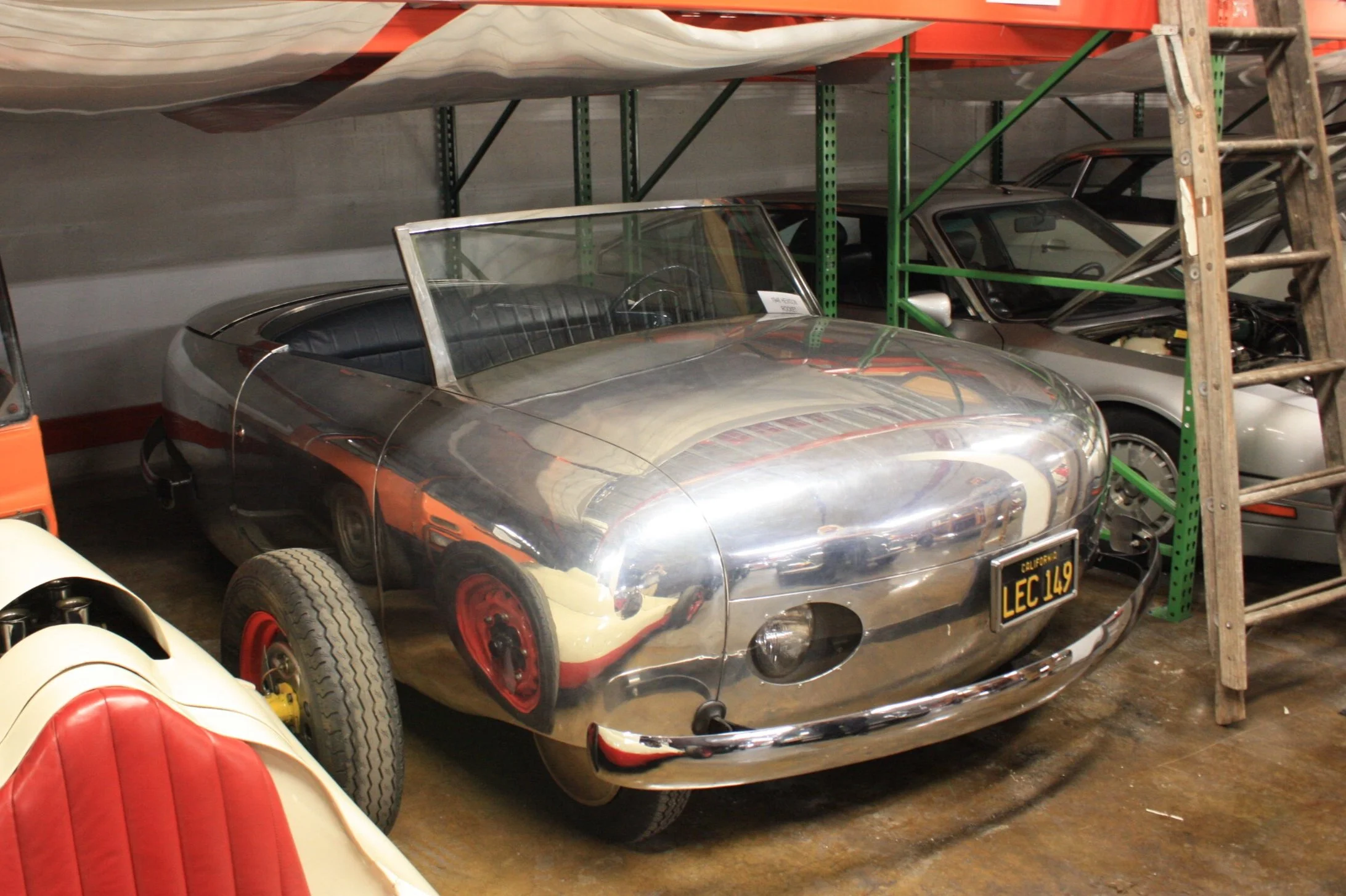
Read MoreThe Hewson Rocket was conceived by Southern Californian, William “Shem’ Hewson, who set out to design a low priced sportster that was fun to drive and have the latest in rocket age aerodynamics. Few other cars have ever employed a trapazoidal wheel pattern, where a car’s front and rear axles differ significantly from each other in length (meaning it leaves four distinct sets of tire tracks) And only the exhalted Citreon DS was a comercial success. But whereas the DS was considered a “Goddess” among cars, the Rocket proved to be all too mortal.
Read MoreDedicated to remembering the lost carmakers, the orphan brands, that are such a rich part of the history of the American automobile